Distinguished guests:

domingo, 13 de março de 2016

The Poles of the Sierra


In July 1832, a place of prayer and seclusion turned into a bloody battlefield. 


 During the Civil War, the monks at the Serra do Pilar Monastery learned of the arrival at Porto of the liberal troops, commanded by D. Pedro, and  abandonned the immense convent, located on the southern bank of the River Douro, in Vila Nova de Gaia – a strategical positon, overlooking both Porto and Gaia. 

"PLANTA TOPOGRAPHICA DA CIDADE DO PORTO" - 1839

In following August, the convent was occupied by some liberal troops and on the 8th September, the then Colonel – future General - José Antonio da Silva Torres was appointed Commander of the stronghold. 


  On that very same day, the liberal troops repelled the first attack of the enemy forces – the Absolutist Army. The Commander of the liberal troops, then Colonel Bernardo de Sá Nogueira, was seriously wounded by a bullet in the right arm – which he lost - and had to hand over command to Major Bravo, which, though always repelling the enemy, had to take refuge in the Convent. 

- Serra do Pilar in 1833 - by Joaquim Villanova
As the troops of D. Miguel approached the convent, a large group of Gaienses (inhabitants of Gaia) led by Major Fontoura, went to the Convent to help the liberal defenders.


After a vicious and bloody struggle, which lasted for 7 hours, the “Miguelistas” had to withdraw. On the next day, September 9, a new attack was inflicted on the stronghold of the Pilar, which was immediately repealled, with bold enthusiasm and courage. 

 On the right side: a soldier of the 3rd Mobile Battallion - Serra do Pilar - nicknamed "The Poles" - as seen in the XIX Century book "History of the Siege of Porto" by Luz Soriano.


On the 29th of the same month, three “Miguelista”columns attacked at full strenght the Gaiense stronghold, but, again had to withdraw, after six hours of fierce combat.On October 13th, at six o'clock in the morning, the “Miguelistas” started a vicious artillery barrage, constantly  firing five batteries against the mountain convent building. It lasted for 33 hours.At end of the bombardment, in the afternoon of the 14th October 1832, the troops of D. Miguel, divided into three columns, assaulted the liberal trenches on 3 differnet locations - Eira,  Cerca and Calçada.


The defenders of the Convent, amongst them many Gaienses, vigorously repelled the attackers, who for six times, tried, again and again, to overcome them. After three hours of bloodshed and vicious hand to hand fighting, the Miguelistas began to leave the field, already covered with six hundred dead and wouded.
This liberal victory was the largest military contribution to the triumph of Don Pedro. Some say it was him who, being told of the heroism of the Serra do Pilar fighters, gave them the honorable epithet of Poles, equaling them to the heroic Sons of Poland, who had so bravely and recently fought against the Russian Army for the freedom of their country in the November Uprising.
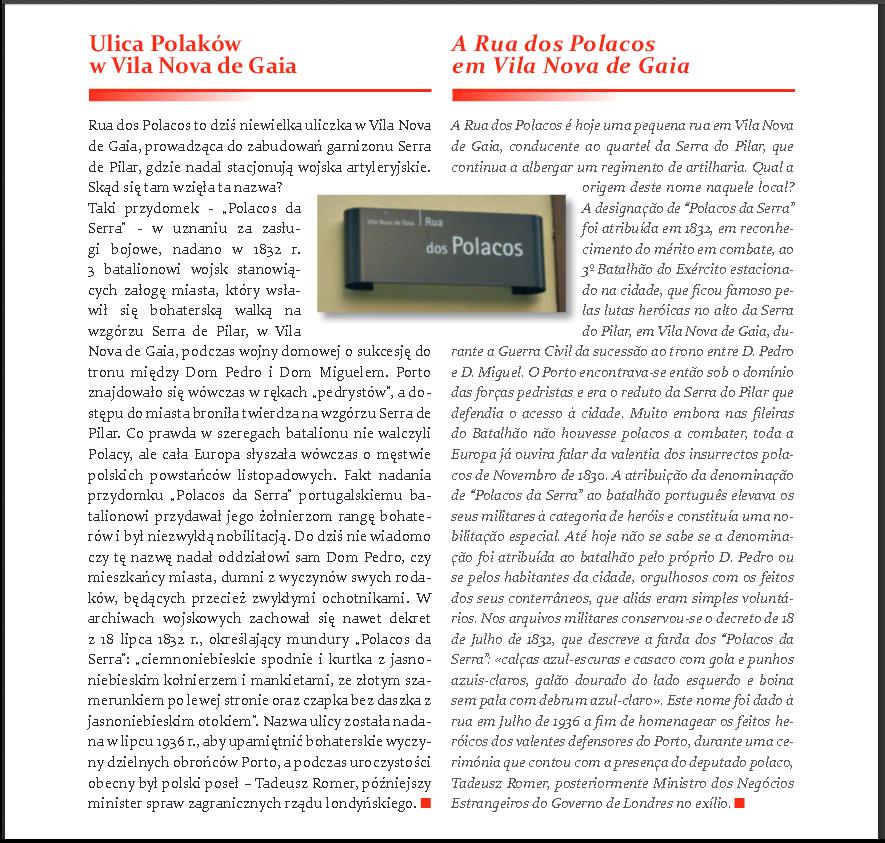

A very interesting and informative text, included in a .pdf file published by the Polish Embassy in Portugal, describing the contacts and friendship between Portugal and Poland along the centuries. Link here


 Viva Portugal!

                                                               
  Viva El-Rei!

                                                                  
Viva a Constituição!

Dedykowane do mojego przyjaciela Michał  który jest prawdziwy Polak! :D

sábado, 5 de março de 2016

House of Aviz


The House of Aviz was the second dynasty of the kings of Portugal, established as a result of the dynastic crisis following the 1383 death of King D. Fernando.


 In April 1385, amidst popular revolt and civil war, the Cortes of Coimbra declared John, Master of Aviz, as king John I of Portugal. He was Fernando´s half-brother and natural son of Fernando's father and predecessor, Pedro I.


The following period of Portuguese history saw the ascent of Portugal to the status of a European and world power.


The conquest of Ceuta in 1415 was its first venture in colonial expansion, followed by a great outpouring of national energy and capital investment in the exploration of Africa, Asia and Brazil with the founding of colonies to exploit their resources commercially. 


The period also includes the zenith of the  Portuguese Empire during the reign of Manuel I and the beginning of its decline during John III´s reign.


 The House of Aviz would rule Portugal until Philip II of Spain annexed Portugal in 1580.


 In the background, behind this proud - and slightly overweight - Herald, a parcial view of the Pastrana Tapestry.


Commissioned by King Afonso V (1432-1481) and expertly woven in Belgium's Tournai workshops in the late 1400s, the Pastrana Tapestries are singular for their depiction of a contemporary subject: Afonso's military campaigns in North Africa - notably, the conquest of Arzila, on 24 of August, 1471. 


Dedicado à Cristina Braz, apreciadora de História e incansável divulgadora deste modesto blogue  :)


domingo, 28 de fevereiro de 2016

O Cerco do Porto - 1832-33 - Siege of Oporto

A Guerra Civil Portuguesa, também conhecida como Guerras Liberais, Guerra Miguelista ou Guerra dos Dois Irmãos desenrolou-se entre 1828 e 1834. Confrontaram-se os liberais constitucionalistas, de um lado, e absolutistas, do outro: estava em causa a sucessão real, e o regime politico que iria vigorar no País. Em causa estava o respeito pelas regras de sucessão ao trono português face à decisão tomada pelas Cortes de 1828, que aclamaram D. Miguel I como rei de Portugal. Os liberais entendiam que o trono pertencia à Rainha D. Maria II - que contou com o apoio de seu pai, D. Pedro IV. 
Um dos seus recontros decisivos foi o Cerco do Porto, durou mais de um ano — entre Julho de 1832 e Agosto de 1833. As tropas liberais de D. Pedro, que entraram na Cidade após o desembarque do Mindelo, aqui ficaram sitiadas pelas forças realistas, fiéis a D. Miguel. Entre a tropa liberal contavam-se diversos Batalhões de Voluntários, muitos dos quais criados por D. Pedro durante o Cerco. São estes corajosos homens o tema da publicação de hoje.
 Não tendo encontrado representações gráficas ou descrições dos uniformes usados pelos oficiais, utilizei as cores dos atribuídos aos soldados.

Oficial/Officer - 1º Batalhão Móvel do Porto/ Oporto 1st Mobile Battalion

Oficial/Officer - Batalhão de Voluntários da Rainha / Queen´s Volunteer Battalion
 The Portuguese Civil War, also known as Liberal Wars, Miguelista War or War of the Two Brothers took place between 1828 and 1834. It opposed the liberal constitutionalists, on one side, and the absolutists, on the other: at stake was the royal succession, and the political regime that would rule the country. The main issue was the respect for the rules of succession to the Portuguese throne: the "Cortes" of 1828 hailed Miguel I as King of Portugal, but for  the Liberals, the throne belonged to Queen Mary II - who had the support of her father, Dom Pedro IV.  One of the decisive clashes was the Siege of Porto, which lasted more than a year - between July 1832 and August 1833. The liberal troops of D. Pedro, who entered the city after landing in Mindelo, were under siege by the royalist forces, faithful to D. Miguel. Among the liberal troops were several battalions of volunteers, many of them created by D. Pedro during the Siege. These brave men are the subject of today's post.  I found no illustrated representations or written descriptions of the uniforms worn by officers, so I used the colors assigned to the soldiers.


Soldado/Soldier - Batalhão Académico/"Academic Battalion"


                   Inspirei-me na obra "Historia do Cerco do Porto", de Luz Soriano, que ali combateu.
                  A gravura, inserida em edição posterior da obra (edição original, não era ilustrada)  representa o uniforme dos Voluntários da Raínha como tendo os punhos azuis e orlados de preto. No entanto, Luz Soriano descreve-os como sendo orlados a branco, pelo que segui o seu texto: 

               
               I was inspired in the book " History of the Siege of Porto" by Luz Soriano, who fought there. 
             The illustration, inserted in the later editions of his work (the original edition had none) depicts the uniform of the Queen´s Volunteers as having blue cuffs, fringed in black . However , Luz Soriano describes them as having white fringes - so I followed his words.

sábado, 13 de fevereiro de 2016

Baron Leopold Von Jaeger III - at your service.

"Baron von Jaeger is rather unique, an eccentric, may be even a madman, but irreplaceable nonetheless."


 "Jaeger considers himself a hunter more than a military man; he spent his childhood honing the art of the hunt in the jungles of House Piquarde, near Helmutsport on Venus. The skills he developed while hunting Devilcat, Venusian Python and alike on his ancestral home, have placed him in good stead within the Bauhaus Military and specifically the Bauhaus Artillery Korps (BAK), where he has excelled for 40 or so years.
He is a strange sight to behold upon the battlefield, decked in the finery of a Bauhaus Kapitan, over which he wears his tatty fifty year old heavy leather hunting jacket. Perched upon his arm is his faithful hunting hawk ‘Hans’. He wears a monocle and has the most  magnificent of moustaches."


"Jaeger’s talents have afforded him the leniency of his superiors in regards to his less than standard tactics and  ppearance. When an enemy needs to be hunted in a brash show of Bauhaus military force, Jaeger is the man for the job. His befuddled  ppearance belies a shrewd and tactical mind, a mind that sees a battle as something beneath him; much rather would he be hunting down a stealthy and intelligent foe in a series of precise attacks and feints, finally finishing the worthy opponent in a large, precise and devastating bombardment, obliterating them from existence. He scorns any mission given to him that does not spark his hunter’s interest, giving it the least of his attention. This has led to no end of disciplinaries, but his exemplary record elsewhere has ensured his current batch of superiors utilise the ‘old Baron’ where he is at his best."


"Jaeger will always be found amongst the howitzers and cannons of his korps, surrounded by tables filled with maps and antiquated instruments of cartography and survey, reams of ink and guava splattered plans billow in the wind, detailing his target and the intricacies of the particular hunt. He will often go beyond his station, taking control of the larger army, ignoring the counter of his field superiors, wielding their men as if his own. Placing them, repositioning them and distributing them ready so that they will funnel the prey. Constantly muttering to himself as he discusses his plans with Hans, often getting into loud argument with the tempestuous bird as it’s ‘suggestions’ infuriate the Baron."


"Eventually, the moment will come when he has positioned, or funnelled, his prey. ‘Check mate’ he will mutter under his breath as Hans squawks and flaps in excitement. ‘FIRE!’ he screams before his guns reply."

Text from Prodos site:  http://shop.prodosgames.com/en/bauhaus-troops/139-baron-leopold-von-jaeger-iii.html

segunda-feira, 8 de fevereiro de 2016