Distinguished guests:

sábado, 16 de abril de 2016

King Afonso V

Afonso V  (15 January 1432 – 28 August 1481), called "o Africano" (the African) was King of Portugal and the Algarves. His sobriquet refers to his conquests in Northern Africa. He was born in Sintra, the eldest son of King Edward of Portugal and his wife, Leonor of Aragon.


During the reign of his grandfather, João I, Ceuta had been conquered from the king of Morocco, and now the new king wanted to expand the conquests.

Siege of Arzila (Asilah) - Pastrana Tapestries - c.1475-1500
The king's army conquered Alcácer Ceguer (1458), Tangiers (won and lost several times between 1460 and 1464) and Arzila (1471).


 When the campaigns in Africa were over, Afonso V found new grounds for battle in neighbouring Castile. In 1474, King Henry IV of Castile died without a male heir. From his two marriages, only a daughter, Joana of Castile, had been born. But her paternity was questioned, and it was rumoured that the queen, Joana of Portugal, had an affair with a nobleman named Beltrán de La Cueva.


Her father's half-sister, the future Queen Isabella I of Castile, was due to inherit the crown, but Afonso V was persuaded to intervene in the succession. In 1475 he married his niece Jonna, whom he considered the legitimate heir to the crown. He proclaimed himself King of Castile and León and prepared to defend his wife's rights. 

Afonso V´s Royal Standard during the Castillian War of Succession: the Leon & Castille coat of arms was added to the Royal Portuguese flag.

 After the indecisive Battle of Toro in 1476 against King Ferdinand II of Aragon, the husband of Isabella I of Castile, he went to France to obtain the assistance of Louis XI, but finding himself deceived by the French monarch, he returned to Portugal in 1477. 


Afonso V´s personal "enterprise": a watermill, spreading silver waterdrops

Disillusioned, he abdicated in favour of his son, João II. After this, he retired to a monastery in Sintra where he died in 1481.

sábado, 9 de abril de 2016

The Perfect Prince

John II,  "The Perfect Prince", (born 1455 at Lisbon, Portugal — died October 1495, Alvor; Portugal), King of Portugal from 1481 to 1495, is regarded as one of the greatest Portuguese rulers, chiefly because of his ruthless assertion of royal authority over the great nobles and his resumption of the exploration of Africa and the quest for India.


John was the great-grandson of the founder of the House of Aviz, John I. He fought bravely alongside his father King Afonso V during the conquest of Arzila in Morocco, thus winning his knighthood, as was the Aviz tradition,. In 1474 his father entrusted him the “trade of Guinea” and the African explorations. When Afonso V claimed the Castilian throne in opposition to Isabella I, he appointed John his regent (April 1475). John mobilized an army and marched to support his father.


The ensuing Battle of Toro (March 1476)  had an inconclusive military outcome, but added to the Prince´s prestige: his father´s troops were beaten by the Castilian left-centre, but his own Battle defeated the Castilian right wing, leaving him with the possession of the battlefield.


However, Afonso´s defeat was a tremendous political victory for the Catholic Monarchs, assuring them the throne of Castile. An ashamed Afonso V departed to France in a fruitless search for an alliance, while John defended the frontier and parried a Spanish counterattack. Afonso’s lack of success caused him to announce his abdication. John was proclaimed king, but his father returned and resumed his reign, concluding the disadvantageous Treaty of Alcáçovas before his death in August 1481.


When he became King, John summoned the Cortes  at Évora (November 1481) and imposed a drastic oath of obedience on his vassals. He also reasserted the beneplacet, requiring papal letters to be submitted to him before publication.  


 He accused the powerful  Duke of Bragança of treason and had him tried and beheaded at Évora (June 1483). Although evidence was produced that the Braganças had intrigued with Castile, it seems clear that John sought vengeance for their having caused the death of his maternal grandfather, the regent Dom Pedro.


 He confiscated the Braganças’ vast estates and appointed royal judges in what had been private jurisdictions of the nobility. When a second conspiracy sought to remove him and bestow the crown on his wife’s brother the Duke of Viseu, John killed his rival with his own hand (August 1484).


He suffered a long illness and died in 1495 at the small castle of Alvor in the Algarve - some say he was poisoned. John’s exercise of personal power, particularly against the nobles, explains the epithet the Perfect Prince, which owes its origin to Lope de Vega’s play about him.

 
 His personal colours were green and purple. He chose "Pela Lei e Pela Grei" (For  Law and for Nation) as his motto; the symbol of his personal entreprise was a pelican feeding its young with its own blood. 


sábado, 19 de março de 2016

The first European Military Mission to Ethiopia


Cristóvão (or Christopher) da Gama was the son of Vasco da Gama and younger brother of Estêvão da Gama. 

He first came to India in 1532 with his brother; returned to Portugal in 1535, then joined Garcia de Noronha in sailing to Diu 6 April 1538. Many times in these travels he demonstrated a quick mind that saved his companions. In recognition of his valour, in 1541, his brother Estêvão, then Viceroy of India, gave him command of a ship in the fleet Estêvão led into the Red Sea against the Ottoman naval base at Suez.

Between 1528 and 1540, the army of Imam Ahmad ibn Ibrihim al-Ghazi, mainly composed of Somalis, Afari, Arabs and Ottoman Turks, had entered Ethiopia, overrunning the Abyssinian Kingdom.

The Emperor took refuge in the remotely located mountain fortresses, and turned to the Portuguese for help.

João Bermudes, a subordinate member of the Portuguese mission of 1520, who had remained in the country after the departure of the embassy, was sent to Lisbon. 

Subsequentely, a Portuguese fleet under the command of Estêvão da Gama, was sent from India and arrived at Massawa in February 1541.
Here he received an ambassador from the Emperor beseeching him to send help against the Muslims. In the following July, a force of 400 musketeers, under the command of Dom  Cristóvão da Gama, marched into the interior, and  joined the native troops.

Alongside his Ethiopian allies, Dom Cristóvão was victorious against larger forces in four battles, but was seriously wounded in the last one, the Battle of Wofla (28 August 1542). His arm broken by a bullet, he was captured on that very night by followers of Imam Ahmad, and brought to his presence.
The Imam tortured his captured opponent, in an attempt to force him to convert to Islam.

Frustrated by da Gama´s fortitude,  the Imam eventually drew his sword and beheaded him.

On February 21, 1543, however, Iman Al-Ghazi was shot and killed in the Battle of Wayna Daga by one of da Gama´s arquebusiers, and his forces were totally routed.


 Sir Richard Burton, in his First Footsteps in East Africa, referred to him as "the most chivalrous soldier of a chivalrous age." His actions were essential for the survival of Christianity in Ethiopia.

 An account of this campaign in the Ethiopian highlands was later written by Miguel de Castanhoso, who accompanied da Gama and was an eye-witness to almost everything he recorded. The 1564 edition of his book "Historia das cousas que o muy esforçado capitão Dom Christouão da Gama fez nos Reynos do Preste Ioão com quatroce[n]tos portugueses que consigo leuou"  can be found here (in Portuguese)

Miguel de Castanhoso´s book cover - 1564 edition


Excerpt from "Historia das cousas..." by Castanhoso
Castanhoso describes Dom Cristóvão´s forces flags, 
" ... the Captains with their soldiers, all with arquebuses, with their blue and white damask banners with red crosses, and the Royal Flag of  carmine and white damask, with the Cross of Christ.
(I found both, excellently drawn and painted here)


Castanhoso also describes da Gama´s clothing when he first met the Ethiopian Queen:  "And the Capitão-Mor (was) very gentlemanly dressed, wearing gold and purple satin trousers and doublet  with many plaits, and a French cape of fine black cloth, all quilted with gold, and a black cap with a  very rich gold medal".


domingo, 13 de março de 2016

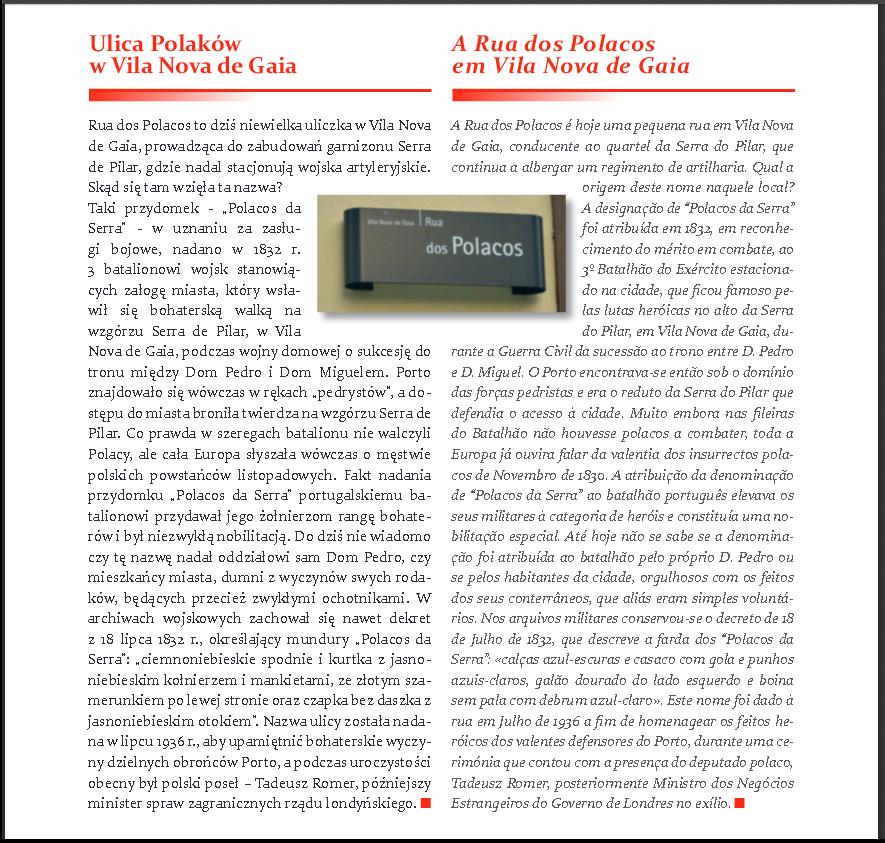
The Poles of the Sierra


In July 1832, a place of prayer and seclusion turned into a bloody battlefield. 


 During the Civil War, the monks at the Serra do Pilar Monastery learned of the arrival at Porto of the liberal troops, commanded by D. Pedro, and  abandonned the immense convent, located on the southern bank of the River Douro, in Vila Nova de Gaia – a strategical positon, overlooking both Porto and Gaia. 

"PLANTA TOPOGRAPHICA DA CIDADE DO PORTO" - 1839

In following August, the convent was occupied by some liberal troops and on the 8th September, the then Colonel – future General - José Antonio da Silva Torres was appointed Commander of the stronghold. 


  On that very same day, the liberal troops repelled the first attack of the enemy forces – the Absolutist Army. The Commander of the liberal troops, then Colonel Bernardo de Sá Nogueira, was seriously wounded by a bullet in the right arm – which he lost - and had to hand over command to Major Bravo, which, though always repelling the enemy, had to take refuge in the Convent. 

- Serra do Pilar in 1833 - by Joaquim Villanova
As the troops of D. Miguel approached the convent, a large group of Gaienses (inhabitants of Gaia) led by Major Fontoura, went to the Convent to help the liberal defenders.


After a vicious and bloody struggle, which lasted for 7 hours, the “Miguelistas” had to withdraw. On the next day, September 9, a new attack was inflicted on the stronghold of the Pilar, which was immediately repealled, with bold enthusiasm and courage. 

 On the right side: a soldier of the 3rd Mobile Battallion - Serra do Pilar - nicknamed "The Poles" - as seen in the XIX Century book "History of the Siege of Porto" by Luz Soriano.


On the 29th of the same month, three “Miguelista”columns attacked at full strenght the Gaiense stronghold, but, again had to withdraw, after six hours of fierce combat.On October 13th, at six o'clock in the morning, the “Miguelistas” started a vicious artillery barrage, constantly  firing five batteries against the mountain convent building. It lasted for 33 hours.At end of the bombardment, in the afternoon of the 14th October 1832, the troops of D. Miguel, divided into three columns, assaulted the liberal trenches on 3 differnet locations - Eira,  Cerca and Calçada.


The defenders of the Convent, amongst them many Gaienses, vigorously repelled the attackers, who for six times, tried, again and again, to overcome them. After three hours of bloodshed and vicious hand to hand fighting, the Miguelistas began to leave the field, already covered with six hundred dead and wouded.
This liberal victory was the largest military contribution to the triumph of Don Pedro. Some say it was him who, being told of the heroism of the Serra do Pilar fighters, gave them the honorable epithet of Poles, equaling them to the heroic Sons of Poland, who had so bravely and recently fought against the Russian Army for the freedom of their country in the November Uprising.


A very interesting and informative text, included in a .pdf file published by the Polish Embassy in Portugal, describing the contacts and friendship between Portugal and Poland along the centuries. Link here


 Viva Portugal!

                                                               
  Viva El-Rei!

                                                                  
Viva a Constituição!

Dedykowane do mojego przyjaciela Michał  który jest prawdziwy Polak! :D